Introduction
The Master in Observability Engineering (MOE) is a comprehensive professional program designed to bridge the gap between basic monitoring and deep system understanding. As modern architectures shift toward microservices and distributed cloud-native environments, the ability to gain insights into complex system behaviors has become a non-negotiable skill. This guide is crafted for engineers and technical leaders who recognize that traditional “dashboarding” is no longer sufficient for maintaining high-availability systems.
By pursuing this certification through DevOpsSchool, professionals gain the technical depth required to navigate the intricacies of telemetry data, distributed tracing, and high-cardinality analysis. This guide helps you understand the roadmap, the investment required, and the long-term career benefits of becoming an observability specialist. Whether you are an SRE, a DevOps engineer, or a technical manager, this path provides the clarity needed to make informed decisions about your professional growth in the cloud-native era.
What is the Master in Observability Engineering (MOE)?
The Master in Observability Engineering (MOE) is an industry-aligned certification program that focuses on the science of understanding internal system states based on external outputs. Unlike traditional monitoring which tells you when something is “down,” MOE teaches you “why” something is behaving unexpectedly. It represents a shift from reactive troubleshooting to proactive reliability engineering.
This program exists to standardize the knowledge required to manage modern, complex infrastructure where failures are often “gray” rather than binary. It emphasizes production-focused learning, using real-world scenarios to teach telemetry collection, analysis, and visualization. It aligns perfectly with modern engineering workflows by integrating observability into the entire software development lifecycle (SDLC).
Who Should Pursue Master in Observability Engineering (MOE)?
This certification is primarily designed for SREs, DevOps engineers, and Platform engineers who are responsible for the reliability and performance of production systems. Cloud architects and security professionals also benefit significantly, as observability is the foundation for both infrastructure scaling and threat detection. It is equally valuable for developers who want to adopt a “you build it, you run it” mindset by understanding how their code behaves at scale.
For beginners, MOE provides a structured entry point into the most critical aspect of modern operations. Experienced engineers use it to formalize their skills and master advanced topics like distributed tracing and eBPF. Engineering managers find value in understanding how to build observability cultures and interpret SLIs and SLOs to make better business-driven technical decisions across global and Indian markets.
Why Master in Observability Engineering (MOE) is Valuable
The demand for observability experts is surging as enterprises move away from monoliths toward thousands of ephemeral microservices. Professionals with these skills are highly sought after because they reduce the “Mean Time To Resolution” (MTTR), which directly impacts a company’s bottom line. This certification ensures long-term career longevity by focusing on core principles that remain relevant even as specific monitoring tools evolve.
Enterprise adoption of observability is no longer optional for high-performing teams. By mastering these concepts, you become a critical asset in any organization that values uptime and performance. The return on time investment is high because the skills learned—such as analyzing high-cardinality data and building resilient feedback loops—are applicable across any cloud provider or technology stack.
Master in Observability Engineering (MOE) Certification Overview
T he certification is structured into logical levels, ensuring that learners build a strong foundation before moving into complex engineering challenges. It uses a practical, assessment-driven approach where candidates must prove their ability to implement observability in live environments.
The ownership of the curriculum lies with industry practitioners who update the content to reflect the latest trends in OpenTelemetry and cloud-native standards. The structure is designed to be modular, allowing professionals to balance their learning with full-time work commitments. Each module concludes with an assessment that validates both theoretical knowledge and hands-on implementation skills.
Master in Observability Engineering (MOE) Certification Tracks & Levels
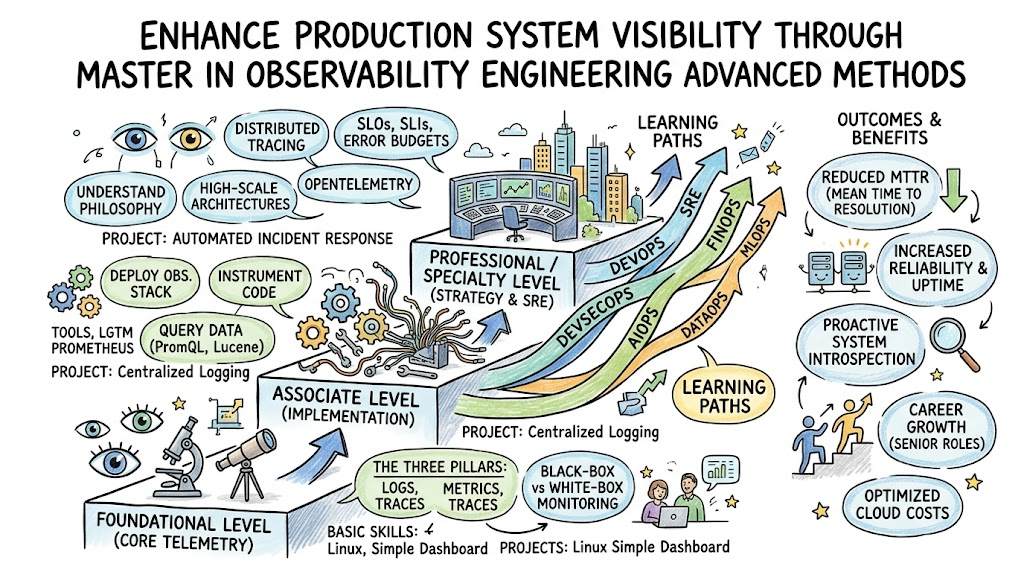
The certification is divided into three primary levels: Foundational, Associate, and Professional. The Foundational level covers the core concepts of metrics, logs, and traces, while the Associate level focuses on tool implementation and telemetry pipelines. The Professional level is the most advanced, dealing with distributed systems architecture and advanced data analysis.
These levels allow for specialization tracks tailored to specific career goals, such as SRE-focused observability or FinOps-focused cost visibility. As you progress through these levels, the complexity of the projects increases, aligning with your career trajectory from a junior engineer to a principal architect. This tiered approach ensures that learning is cumulative and well-structured for long-term retention.
Complete Master in Observability Engineering (MOE) Certification Table
| Track | Level | Who it’s for | Prerequisites | Skills Covered | Recommended Order |
| Core | Foundational | Beginners, Managers | Basic Linux, Cloud basics | Logs, Metrics, Traces | 1 |
| Engineering | Associate | DevOps/Cloud Engineers | Foundational MOE, Docker | Prometheus, Grafana, ELK | 2 |
| Architect | Professional | SREs, Senior Engineers | Associate MOE, Kubernetes | Distributed Tracing, SLOs | 3 |
| Specialty | Advanced | SRE/Platform Leaders | Professional MOE | eBPF, AIOps, Custom Exporters | 4 |
Detailed Guide for Each Master in Observability Engineering (MOE) Certification
Foundational Level
Master in Observability Engineering (MOE) – Foundational
What it is
This certification validates a candidate’s understanding of the basic principles of system visibility. It covers the essential definitions and the conceptual shift from traditional monitoring to modern observability practices.
Who should take it
It is ideal for junior engineers, IT managers, and project leaders who need to understand the terminology and the “why” behind observability without getting bogged down in complex coding initially.
Skills you’ll gain
- Understanding the Three Pillars: Logs, Metrics, and Traces.
- Differentiating between Monitoring and Observability.
- Basic understanding of Service Level Indicators (SLIs) and Objectives (SLOs).
- Knowledge of telemetry data types and collection methods.
Real-world projects you should be able to do
- Define a basic observability strategy for a simple web application.
- Identify the key metrics needed to monitor a standard database.
- Create a high-level plan for implementing logs in a distributed system.
Preparation plan
- 7–14 days: Focus on core definitions, the history of monitoring, and the “Pillars” of observability.
- 30 days: Explore basic open-source tools and read industry whitepapers on SRE practices.
- 60 days: Not usually required for this level, but can be used to deep dive into case studies.
Common mistakes
- Confusing observability with simple dashboarding.
- Ignoring the cultural aspect of observability.
- Over-relying on tool-specific knowledge instead of core principles.
Best next certification after this
- Same-track option: MOE Associate Level
- Cross-track option: Cloud Practitioner Certification
- Leadership option: ITIL or Management Essentials
Associate Level
Master in Observability Engineering (MOE) – Associate
What it is
This level validates the ability to implement and manage observability tools in a production-like environment. It focuses on the “how” of telemetry collection and data visualization.
Who should take it
System administrators, DevOps engineers, and developers with 1-2 years of experience who are responsible for setting up monitoring stacks and alert rules.
Skills you’ll gain
- Mastery of Prometheus for metrics collection and Alertmanager for notifications.
- Advanced Grafana dashboarding and data visualization techniques.
- Implementing ELK/EFK stacks for centralized logging.
- Basic integration of OpenTelemetry into applications.
Real-world projects you should be able to do
- Deploy a full Prometheus and Grafana stack on a Kubernetes cluster.
- Configure log rotation and centralized ingestion for multiple microservices.
- Build custom dashboards that track both infrastructure and application-level metrics.
Preparation plan
- 7–14 days: Intensive lab work with Prometheus and Grafana basics.
- 30 days: Deep dive into PromQL, Logstash filters, and dashboard design.
- 60 days: Full end-to-end implementation of a monitoring stack with alerting.
Common mistakes
- Creating too many alerts resulting in “alert fatigue.”
- Failing to optimize storage for long-term metric retention.
- Building dashboards that are visually complex but lack actionable insights.
Best next certification after this
- Same-track option: MOE Professional Level
- Cross-track option: Certified Kubernetes Administrator (CKA)
- Leadership option: Team Lead or Senior SRE roles
Professional/Specialty Level
Master in Observability Engineering (MOE) – Professional
What it is
The Professional level validates the expertise required to design high-scale observability architectures for complex distributed systems. It focuses on correlation, tracing, and high-cardinality analysis.
Who should take it
Senior SREs, Architects, and Lead Engineers with 5+ years of experience who manage large-scale cloud environments and high-traffic applications.
Skills you’ll gain
- Advanced Distributed Tracing with Jaeger and Zipkin.
- Mastering OpenTelemetry (OTel) for vendor-neutral instrumentation.
- Implementing eBPF for deep kernel-level observability.
- Correlating signals to perform root cause analysis in microservices.
Real-world projects you should be able to do
- Architect a global tracing strategy across multiple cloud regions.
- Implement custom auto-instrumentation for legacy applications.
- Design a high-cardinality metrics storage solution using Thanos or Cortex.
Preparation plan
- 7–14 days: Focus on distributed tracing theory and context propagation.
- 30 days: Hands-on with OpenTelemetry SDKs and collector configurations.
- 60 days: Architecture design projects and advanced performance tuning of the observability stack.
Common mistakes
- Ignoring the performance overhead of instrumentation.
- Failing to correlate traces with logs and metrics.
- Underestimating the cost of high-cardinality data storage.
Best next certification after this
- Same-track option: MOE Advanced Specialty (eBPF/AIOps)
- Cross-track option: FinOps Certified Practitioner
- Leadership option: Principal Engineer or Director of Infrastructure
Choose Your Learning Path
DevOps Path
The DevOps path focuses on integrating observability into the CI/CD pipeline. The goal is to ensure that code is observable by default before it even reaches production. Engineers in this path focus on automated testing of telemetry and using observability to validate deployments through canary and blue-green strategies.
DevSecOps Path
In this path, observability is used as a tool for security forensics and real-time threat detection. By monitoring system calls and network traffic via observability signals, DevSecOps professionals can identify anomalies that signify a breach. It bridges the gap between traditional security monitoring and modern infrastructure visibility.
SRE Path
The SRE path is the most traditional route for observability, focusing heavily on reliability, availability, and performance. Professionals here prioritize SLIs, SLOs, and Error Budgets. The focus is on using observability to automate responses to system failures and reducing the cognitive load during incident response.
AIOps Path
This path explores the use of machine learning to analyze the massive amounts of data generated by observability tools. AIOps practitioners focus on automated anomaly detection and predictive maintenance. They use historical telemetry data to train models that can identify potential issues before they cause downtime.
MLOps Path
Observability in MLOps is about monitoring the performance of machine learning models in production. This includes tracking model drift, data quality, and inference latency. It ensures that the “black box” of AI becomes transparent and accountable within the larger enterprise infrastructure.
DataOps Path
DataOps professionals focus on the observability of data pipelines and processing engines. They track data lineage, quality, and latency across complex ETL/ELT workflows. This ensures that the data driving business decisions is accurate, timely, and consistently available to downstream consumers.
FinOps Path
The FinOps path uses observability to gain visibility into cloud spending and resource utilization. By tagging resources and monitoring usage patterns, professionals can correlate technical performance with financial costs. This enables unit economics and helps organizations optimize their cloud ROI.
Role → Recommended Master in Observability Engineering (MOE) Certifications
| Role | Recommended Certifications |
| DevOps Engineer | MOE Foundational, MOE Associate |
| SRE | MOE Associate, MOE Professional |
| Platform Engineer | MOE Associate, MOE Professional |
| Cloud Engineer | MOE Foundational, MOE Associate |
| Security Engineer | MOE Foundational, DevSecOps Specialty |
| Data Engineer | MOE Associate, DataOps Specialty |
| FinOps Practitioner | MOE Foundational, FinOps Specialty |
| Engineering Manager | MOE Foundational |
Next Certifications to Take After Master in Observability Engineering (MOE)
Same Track Progression
Once you have completed the Master in Observability Engineering, the logical step is to dive deeper into specialized observability technologies. This might include deep-dive courses on eBPF for kernel-level insights or specialized training in advanced OpenTelemetry implementations. Mastering the specific nuances of high-cardinality databases like M3DB or ClickHouse can also be a significant step forward for those managing massive data volumes.
Cross-Track Expansion
Observability does not exist in a vacuum, and expanding into related fields can make you a more versatile engineer. Consider pursuing Kubernetes certifications (CKA/CKAD) since most modern observability is implemented within containerized environments. Security certifications like the CKS (Certified Kubernetes Security Specialist) are also excellent choices, as they allow you to apply your observability skills to the domain of infrastructure protection.
Leadership & Management Track
For those looking to move into leadership, certifications in SRE Management or Platform Engineering leadership are ideal. These programs focus on the human and organizational aspects of engineering, such as building a “no-blame” culture, managing incident response teams, and defining business-aligned reliability goals. Understanding how to communicate the value of observability to non-technical stakeholders is a key skill for any aspiring Director of Infrastructure.
Training & Certification Support Providers for Master in Observability Engineering (MOE)
- DevOpsSchool
As a primary leader in the space, this organization provides extensive hands-on labs and instructor-led training tailored specifically for the Master in Observability Engineering curriculum. Their programs are known for being deeply technical and updated frequently to match the rapid pace of the observability tool ecosystem. They offer a blend of self-paced and live sessions that cater to working professionals globally. - Cotocus
This provider specializes in enterprise-grade training solutions, focusing on the practical application of observability tools within large-scale corporate environments. They offer tailored bootcamps that help teams transition from legacy monitoring to modern observability practices. Their instructors often bring decades of industry experience, providing learners with insights into real-world production challenges and architectural best practices for distributed systems. - Scmgalaxy
This community-centric platform offers a wealth of resources for those pursuing observability certifications, including comprehensive guides and open-source project tutorials. They focus on the integration of observability within the broader DevOps lifecycle, making it a great choice for engineers who want to see the “big picture.” Their content is often driven by community needs, ensuring it stays relevant to common engineering pain points. - BestDevOps
This provider focuses on career-oriented training, helping candidates not only pass the certification but also prepare for high-level SRE and DevOps interviews. Their approach combines technical mastery with soft skills like incident communication and post-mortem documentation. They offer personalized mentorship that helps students map their learning journey directly to their specific career goals within the observability and reliability engineering domain. - devsecopsschool.com
Focusing on the intersection of security and operations, this site provides specialized modules on using observability for threat hunting and security monitoring. Their curriculum is essential for engineers who want to implement “Security Observability” within their organizations. They emphasize the use of telemetry data to identify unauthorized access patterns and ensure compliance across cloud-native infrastructure through continuous visibility. - sreschool.com
This platform is dedicated to the core tenets of Site Reliability Engineering, where observability is a foundational pillar. Their training programs are designed around the Google SRE handbook principles, focusing on SLIs, SLOs, and error budgets. It is the go-to resource for engineers who want to master the reliability aspect of observability and build systems that are inherently resilient to failure. - aiopsschool.com
For those interested in the future of operations, this provider offers cutting-edge training on integrating artificial intelligence with observability data. They teach engineers how to build automated remediation workflows and use machine learning for proactive system health monitoring. Their courses are ideal for professionals looking to reduce manual intervention and move toward “self-healing” infrastructure using advanced data analytics. - dataopsschool.com
This provider bridges the gap between data engineering and observability, offering specialized tracks for monitoring data pipelines and large-scale data processing engines. Their curriculum focuses on data quality, latency, and lineage, ensuring that the entire data lifecycle is visible and manageable. It is an essential resource for data professionals who need to maintain the reliability of high-stakes analytical environments. - finopsschool.com
Focusing on the financial dimension of cloud operations, this site provides training on how to use observability signals to track and optimize cloud costs. They teach the principles of cloud financial management, allowing engineers to provide business leaders with accurate unit cost data. Their courses are vital for organizations looking to scale their infrastructure without losing control of their cloud expenditures.
Frequently Asked Questions (General)
1. To what extent is the Master of Observability Engineering credential challenging?
The difficulty ranges from moderate at the foundational level to high at the professional level, as it requires both theoretical knowledge and hands-on coding.
2. How long does it take to complete the full program?
Most professionals complete the entire track within 3 to 6 months, depending on their prior experience with Linux and cloud technologies.
3. Are there any strict prerequisites for the foundational level?
There are no formal prerequisites, but a basic understanding of how web applications work and familiarity with the command line is highly recommended.
4. What is the return on investment for this certification?
The ROI is significant, as observability is currently one of the highest-paying skill sets in the DevOps and SRE job markets globally.
5. Do I need to know how to code to succeed in MOE?
Basic scripting in Python or Go is very helpful, especially at the associate and professional levels where custom instrumentation is required.
6. Can I take the exams online?
Yes, the certification exams are typically conducted online through proctored platforms, making them accessible to a global audience.
7. How often does the certification need to be renewed?
The certification is usually valid for two to three years, after which a recertification or a higher-level exam is recommended to stay current.
8. Is observability only for Kubernetes users?
No, while Kubernetes is a common use case, observability principles apply to serverless, virtual machines, and even legacy on-premise monoliths.
9. Does the program cover specific tools like Datadog or New Relic?
The program focuses primarily on open-source standards like OpenTelemetry, Prometheus, and Grafana, which are applicable across all vendor tools.
10. How does this differ from a standard DevOps certification?
While DevOps is broad, MOE is a “deep dive” specifically into system visibility, telemetry, and high-scale reliability engineering.
11. Is this certification recognized in India?
Yes, it is highly recognized by top Indian tech firms and global MNCs operating in major hubs like Bangalore, Pune, and Hyderabad.
12. Are there lab environments provided during the training?
Most reputable providers, such as DevOpsSchool, provide cloud-based lab environments to practice implementations in real-time.
FAQs on Master in Observability Engineering (MOE)
1. What is the difference between monitoring and observability in the context of MOE?
Monitoring is the act of collecting and alerting on predefined sets of metrics, essentially telling you if a system is healthy or not based on known patterns. Observability is a property of the system that allows you to understand its internal state by looking at the data it produces, enabling you to debug problems you haven’t seen before. The MOE program teaches you how to build systems that are inherently observable, rather than just adding monitoring as an afterthought.
2. Why is OpenTelemetry emphasized so heavily in the MOE curriculum?
OpenTelemetry (OTel) has become the industry standard for vendor-neutral telemetry collection, and mastering it ensures that your skills are not tied to a single commercial tool. By learning OTel, MOE candidates gain the flexibility to switch between different backends without changing their application code. This “future-proofs” your career and provides organizations with the architectural freedom to choose the best storage and analysis tools for their specific needs.
3. How does the MOE certification help with incident response?
The certification provides a structured approach to “Root Cause Analysis” (RCA) by teaching engineers how to correlate logs, metrics, and traces during a crisis. Instead of guessing what went wrong, MOE-trained professionals can follow the telemetry data to find the exact point of failure. This reduces the time spent in “war rooms” and helps teams restore service much faster, which is critical for maintaining high-availability service level agreements.
4. Can a technical manager benefit from the Master in Observability Engineering?
Yes, technical managers gain the ability to set realistic SLOs and understand the trade-offs between feature development and system reliability. It helps them interpret the data presented in engineering reviews and make better hiring decisions for their SRE and DevOps teams. Understanding the cost and complexity of observability also allows managers to advocate for the necessary resources to maintain a healthy production environment.
5. Does the program cover the cost aspects of observability data?
The MOE curriculum includes modules on data management, focusing on how to handle the “data deluge” without breaking the budget. You will learn about sampling strategies, metric cardinalities, and log retention policies that balance visibility with cost-efficiency. This is a crucial skill because high-scale observability can become prohibitively expensive if not managed with a clear strategy for data ingestion and storage.
6. What role does eBPF play in modern observability engineering?
eBPF (extended Berkeley Packet Filter) allows for deep, low-overhead visibility into the Linux kernel without requiring changes to the application code. In the MOE program, you will learn how eBPF is used for high-performance networking and security observability. It is a game-changer for monitoring microservices where traditional sidecar patterns might introduce too much latency or complexity into the system architecture.
7. How do SLIs and SLOs integrate into the MOE certification?
Service Level Indicators (SLIs) and Service Level Objectives (SLOs) are the mathematical foundation of reliability, and MOE teaches you how to define, measure, and track them. You will learn how to turn raw telemetry data into meaningful business metrics that represent the actual user experience. This alignment between technical performance and business goals is what separates a standard engineer from a Master in Observability Engineering.
8. Is the MOE certification suitable for developers who don’t work in operations?
Absolutely, as the “Shift Left” movement grows, developers are increasingly responsible for the health of their code in production. The MOE program teaches developers how to write “observable code” by using instrumentation libraries and understanding how their services interact in a distributed environment. This leads to better code quality, faster debugging during development, and a more seamless handoff to operations teams.
Final Thoughts: Is Master in Observability Engineering (MOE) Worth It?
The transition from traditional IT operations to modern reliability engineering is one of the most significant shifts in the industry. As systems become more opaque and distributed, the “guesswork” of the past is being replaced by the data-driven insights of observability. Investing in the Master in Observability Engineering (MOE) is not just about learning new tools; it is about adopting a professional mindset that prioritizes transparency, reliability, and continuous improvement.
For the individual engineer, this path offers a clear way to differentiate yourself in a crowded market. For the organization, it provides the insurance needed to scale complex systems with confidence. If you are looking to move beyond basic monitoring and want to become the person who can solve the “impossible” production bugs, this certification is a logical and highly valuable step in your career journey. Use this roadmap to guide your learning, stay focused on the core principles, and embrace the challenge of mastering the modern cloud-native stack.
