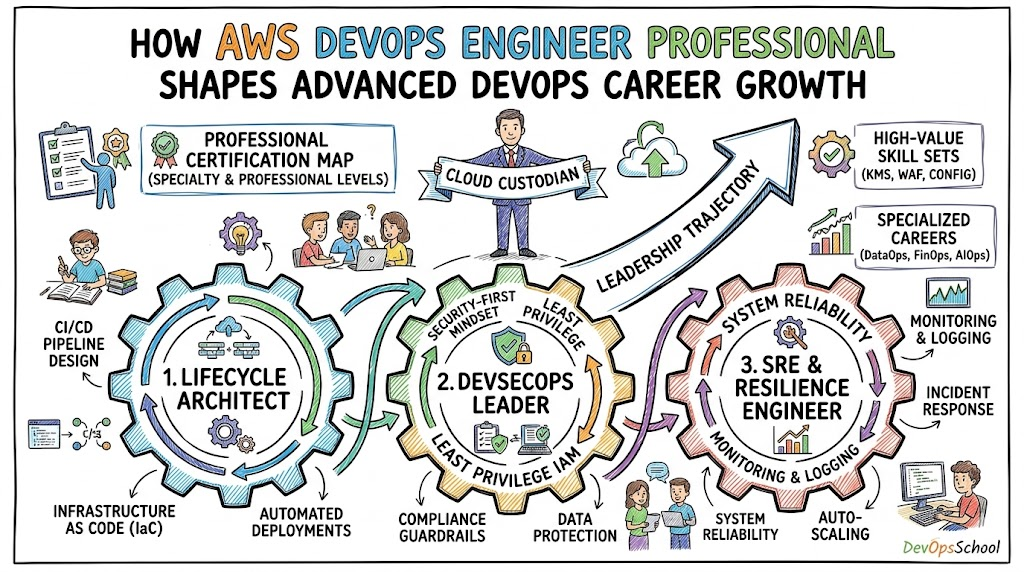
Introduction
In the modern theater of technology, the role of an engineer has evolved into something far more significant than a mere builder of features. We have entered the era of the “Integrity Architect.” As systems become more distributed, ephemeral, and autonomous through the rise of cloud-native technologies, the primary challenge is no longer just “Will it run?” but “Is it safe, resilient, and trustworthy?”
For senior software engineers and technical managers—from the high-tech corridors of Bengaluru and Hyderabad to the global innovation centers of Silicon Valley and London—the definition of excellence has shifted. Mastery over code and infrastructure is now only half the battle. The other half is the mastery of security within the automation lifecycle. This guide is a roadmap for those ready to transition from being cloud participants to becoming the guardians of the cloud frontier, with a specific focus on the AWS Certified Security – Specialty program.
Snapshot of the AWS Certified Security – Specialty Credential
The AWS Certified Security – Specialty credential recognises professionals who can secure real-world workloads running on AWS at scale. It highlights your capability to design and implement strong access control models, apply encryption and key management correctly, and protect applications and networks in complex, multi-account environments. The exam also checks how well you plan logging, monitoring, and threat detection so that suspicious activity is identified and handled quickly. Achieving this certification signals that you can help an organisation operate sensitive, business‑critical, and compliance‑driven systems on AWS with a mature and dependable security posture.
Why Security and Automation are the Twin Pillars of Modern Tech
The traditional “siloed” approach to security is extinct. In an ecosystem where a single misconfigured Terraform script can instantly expose millions of customer records, security cannot be a separate department that reviews code at the end of the month. It must be baked into every line of code, every API call, and every automated deployment.
The industry has moved toward specialized “Ops” disciplines—DevSecOps, SRE, AIOps, and FinOps—to manage this complexity. At the center of all these is a need for robust, automated security. If you are an engineer who can automate security guardrails, you aren’t just an expense; you are a risk-mitigation asset.
For businesses, a secure cloud environment translates to “The Trust Dividend.” Customers are more likely to stay with platforms that demonstrate high-level data integrity. For the engineer, this means that security expertise is currently the most recession-proof skill set in the global job market.
Why Choose DevOpsSchool?
DevOpsSchool is designed to bridge this specific gap. Instead of providing static video lectures, they offer a practitioner-led ecosystem that mimics the high-stakes environment of a modern enterprise.
Their training methodology focuses on Scenario-Based Learning. You aren’t just learning how to configure an AWS service; you are learning how to respond to a breach in the middle of the night, how to audit a multi-account environment for compliance, and how to build automation that prevents human error. For managers, DevOpsSchool represents a quality standard—a signal that an engineer is ready to handle real-world production responsibilities from day one.
AWS Certified Security – Specialty Table
| Track | Level | Who it’s for | Prerequisites | Skills Covered | Recommended Order |
| Security | Specialty | Security Leads, DevSecOps Engineers | 2+ Years AWS Exp | Cryptography, IAM, Logging, Incident Response | After Associate |
| DevOps | Professional | SREs, Automation Leads | 2+ Years AWS Exp | CI/CD, SDLC, HA, Monitoring | After Associate |
| Solutions Architect | Professional | Senior Architects, Tech Directors | Associate Cert | Design for Complexity, Migration | After Associate |
| SysOps | Associate | Systems Administrators | Cloud Practitioner | Deployment, Management, Health | Step 2 |
| Developer | Associate | Software Engineers | Cloud Practitioner | SDKs, Serverless, App Lifecycle | Step 2 |
Deep Dive: AWS Certified Security – Specialty (SCS-C02)
What it is
The AWS Security Specialty is a high-level credential that validates your technical ability to secure the entire AWS platform. It isn’t just about knowing the tools; it’s about understanding how to design defense-in-depth strategies across thousands of distributed resources.
Who should take it
This is a “must-have” for Security Engineers, Lead Developers, and Cloud Architects. It is also highly valuable for Engineering Managers who need to lead secure migrations or oversee compliance-heavy projects in sectors like Fintech, Healthcare, or Government.
Skills you’ll gain
- Identity Governance: Building complex IAM structures, Service Control Policies (SCPs), and permission boundaries.
- Data Sovereignty: Managing encryption at scale with AWS KMS, CloudHSM, and Secrets Manager.
- Network Hardening: Implementing VPC Endpoints, WAF, and Shield to protect against Layer 7 and Layer 3/4 attacks.
- Proactive Monitoring: Mastering GuardDuty, Security Hub, and Macie for automated threat hunting.
- Automated Remediation: Writing Lambda-based logic to automatically fix security drift.
Real-world projects you should be able to do after it
- Automated Forensic Vault: Design a system that automatically snapshots a compromised disk, moves it to an isolated account, and starts an analysis log.
- Zero-Trust Media Pipeline: Build a content delivery system where every internal service requires a short-lived, encrypted token to communicate.
- Compliance-as-Code Engine: Create a library of AWS Config rules that prevents any non-encrypted database from being launched in the organization.
- Multi-Region Encryption Strategy: Implement a centralized KMS architecture that handles cross-region disaster recovery for sensitive financial data.
Preparation Plan
- 14 Days (The Specialist Sprint): Focused on those with heavy AWS experience. Spend 4 hours a day on official FAQs, Security Whitepapers, and intensive mock tests.
- 30 Days (The Career Pivot): The most common route. 2 hours daily. 2 weeks on Labs (KMS, IAM, VPC), 1 week on monitoring tools, and 1 week on exam strategy.
- 60 Days (The Deep Mastery): For those coming from non-cloud backgrounds. Month 1 focuses on the AWS Associate level knowledge. Month 2 focuses on specialized security deep dives and scenario-based labs.
Common Mistakes
- Over-reliance on ‘The Console’: The exam often asks how you would do things via the CLI or CloudFormation.
- Ignoring IAM Evaluation Logic: Many fail because they don’t understand how “Explicit Deny” overrides everything else in complex policy stacks.
- Focusing too narrowly: Security isn’t just IAM; you must understand the security implications of networking and storage as well.
Best next certification after this
- Same-track option: AWS Certified Solutions Architect – Professional.
- Cross-track option: Certified Kubernetes Security Specialist (CKS).
- Leadership option: CISM (Certified Information Security Manager) or CISSP.
Choose Your Path
Security is the common thread through these six specialized career trajectories:
- DevOps Path: Focus on the “Pipeline.” You ensure that security is a gate within the automated delivery system.
- DevSecOps Path: Focus on the “Integration.” You bridge the gap between developers and security officers, making protection invisible and automatic.
- SRE Path: Focus on “Resilience.” You treat security failures as reliability issues, building systems that can withstand and recover from attacks.
- AIOps/MLOps Path: Focus on “Intelligence.” You use data models to detect anomalies and threats that a human would miss in billions of log lines.
- DataOps Path: Focus on “Privacy.” You ensure that the lifecycle of data—from ingestion to archival—is encrypted and compliant.
- FinOps Path: Focus on “Value.” You ensure that security tools are cost-effective and that the cloud bill doesn’t explode due to over-provisioning security logs.
Role → Recommended Certifications Mapping
| If you are a… | Recommended Path | Why? |
| DevOps Engineer | AWS DevOps Prof + Security Specialty | To own the full end-to-end delivery safety. |
| SRE | AWS SysOps + Security Specialty | To ensure platform reliability and defense. |
| Platform Engineer | CKA + AWS Solutions Architect Prof | To build the foundational substrate for teams. |
| Cloud Engineer | AWS Solutions Architect Assoc + Security | To transition into high-paying security roles. |
| Security Engineer | AWS Security Specialty + DevOps Prof | To automate your defense strategies. |
| Data Engineer | AWS Data Engineer + Security Specialty | To protect sensitive data pipelines. |
| FinOps Practitioner | AWS Cloud Practitioner + FinOps Cert | To manage cloud economics and costs. |
| Engineering Manager | AWS Cloud Practitioner + Security Specialty | To lead with a risk-aware mindset. |
Top Institutions for AWS Security Training
To master a specialty certification, self-study is often not enough. These institutions provide the expert mentorship required:
- DevOpsSchool: A leader in hands-on technical training. Their programs are built by industry veterans and focus on real-world implementation, making them the top choice for those seeking job-ready skills.
- Cotocus: Specializes in high-end corporate training and technical consulting. They are excellent for senior engineers looking for deep-dive architectural workshops.
- Scmgalaxy: A massive repository of community-driven technical knowledge. They provide extensive blogs and free resources that are invaluable for exam preparation.
- BestDevOps: Focuses on the intersection of modern tools and traditional engineering. Their training is highly vocational and aimed at career growth.
- devsecopsschool.com: The primary destination for those looking to specialize exclusively in the “Shift Left” movement and automated security.
- sreschool.com: A dedicated platform for site reliability engineering, focusing on building systems that are both secure and unbreakable.
- aiopsschool.com: Perfect for engineers looking to integrate machine learning and artificial intelligence into their operational workflows.
- dataopsschool.com: Specialized training for data professionals who need to manage the security of massive data lakes and pipelines.
- finopsschool.com: The go-to for learning the financial side of the cloud, focusing on cost-optimization and economic transparency.
Career Growth & Certification FAQs (Beginner Friendly)
1. Is it possible to start with a Specialty certification?
While AWS allows it, it is not recommended. You should ideally have the knowledge of an Associate-level certification first to understand how the core services work.
2. How much does a certification help in an interview?
A certification gets you past the HR filters and proves you have a “baseline” of knowledge. In the technical round, you must demonstrate the skills you learned during the cert prep.
3. Do I need to be a programmer to work in Cloud Security?
You don’t need to be a software developer, but you must be comfortable with scripting (like Python or Bash) and reading configuration files (YAML/JSON).
4. What is the average salary hike after getting the AWS Security Specialty?
In India and globally, specialized security professionals can see salary increases of 25% to 50% compared to generalist cloud engineers.
5. How long is the exam?
The exam is 170 minutes long and consists of 65 questions. It requires significant stamina and focus.
6. Is there a physical lab in the exam?
No, the exam is currently multiple-choice and multiple-response, but the questions are designed so that only someone with lab experience can choose the correct answer.
7. Can I take the exam in my local language?
AWS offers exams in multiple languages, but English is the standard for the global tech industry and has the most study materials available.
8. What happens if my certification expires?
You will lose your “Certified” status on LinkedIn and your digital badge. You must retake the current version of the exam to renew it.
9. Is this certification recognized outside of India?
Yes, AWS certifications are the global standard. A certification earned in India is equally valid in the US, Europe, or Australia.
10. I am a manager; will this cert help me lead my team?
Absolutely. It gives you the technical vocabulary to challenge your architects and ensure that the solutions they propose are actually secure.
11. Does AWS offer free training?
Yes, AWS Skill Builder has many free digital courses, but for deep, hands-on mastery, mentored programs like those at DevOpsSchool are recommended.
12. How do I book my exam?
You can book your exam through the AWS Training and Certification portal. You can take it at a testing center or from your home via online proctoring.
AWS Certified Security – Specialty (SCS-C02) Technical FAQs
1. What is the “Key” service to master for this exam?
AWS KMS (Key Management Service). You must understand the difference between CMKs, Data Keys, and how key policies work.
2. How much networking do I need to know?
You need to be an expert in VPC security. This includes Security Groups, NACLs, VPC Flow Logs, and Traffic Mirroring.
3. What is the difference between AWS Shield and AWS WAF?
Shield is for DDoS protection at layers 3 and 4. WAF is for web-based attacks (like SQLi or XSS) at layer 7. You need to know when to use which.
4. What is ‘AWS Macie’ and why is it important?
Macie uses machine learning to automatically discover and protect sensitive data (like PII) stored in S3 buckets.
5. How do I manage security across 100+ AWS accounts?
You use AWS Organizations and Service Control Policies (SCPs). This is a major topic on the exam.
6. What is ‘Logging’ vs ‘Monitoring’ in the AWS context?
CloudTrail is for logging (auditing who did what). CloudWatch is for monitoring (watching performance and system health).
7. Is AWS Inspector useful for security?
Yes, it automatically assesses applications for vulnerabilities or deviations from best practices, specifically on EC2 instances and ECR images.
8. How do I automate a response to a security event?
The “Standard” answer is using Amazon EventBridge to trigger an AWS Lambda function that remediates the issue.
Conclusion
The transition from a generalist engineer to a Security Specialist is the most significant career move you can make in the current market. By mastering the AWS Certified Security – Specialty, you aren’t just learning a tool; you are adopting a mindset of “Default Security.”
Whether you are looking to climb the ladder within your current organization or seeking new opportunities globally, the path is clear. Use the resources provided by DevOpsSchool, follow the roadmap, and commit to the process. The cloud of tomorrow will be built by those who understand how to protect it today. Your journey toward becoming an Integrity Architect starts now.
