Introduction
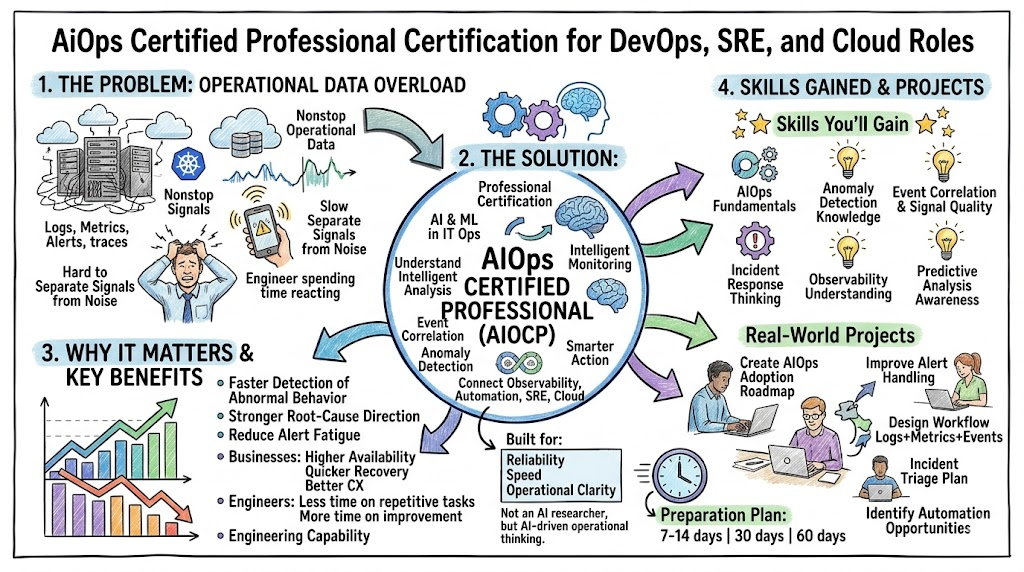
Artificial intelligence is changing how operations teams manage modern systems. Today, software runs across cloud platforms, Kubernetes clusters, microservices, APIs, and hybrid environments that produce nonstop operational data. Logs, metrics, alerts, traces, and events arrive in large volume, and teams often struggle to separate useful signals from background noise. When this process stays fully manual, incident response becomes slow, root-cause analysis becomes harder, and engineers spend too much time reacting instead of improving systems.
The AiOps Certified Professional (AIOCP) certification is designed for professionals who want to understand how intelligent operations can improve this situation. It helps software engineers, DevOps professionals, SREs, cloud engineers, platform teams, and managers learn how AI-supported methods can make operations more proactive and efficient. This guide explains the purpose of AIOCP, its practical value, the type of professionals who should pursue it, and how it can fit into a modern engineering career path.
What is AiOps Certified Professional (AIOCP)
AiOps Certified Professional (AIOCP) is a professional certification that focuses on the use of AI and machine learning techniques in IT operations. Its purpose is to help professionals understand how intelligent analysis can improve monitoring, troubleshooting, event correlation, anomaly detection, incident handling, and automation. Instead of depending only on dashboards and manual investigation, AIOps introduces a smarter way to process operational data and turn it into action.
This certification is built for people who work in modern software and infrastructure environments where reliability, speed, and operational clarity matter. It teaches how AIOps fits with observability, automation, DevOps, SRE, and cloud operations. The goal is not to make learners into AI researchers. The real goal is to help engineers and managers apply AI-driven operational thinking in practical environments.
Why it Matters in Today’s Software, Cloud, and Automation Ecosystem
Software systems have become more dynamic, more distributed, and more difficult to manage with traditional operations methods alone. Containers start and stop quickly, microservices create large amounts of telemetry, and cloud-native systems generate more operational complexity than older environments. This makes it difficult for teams to understand service health through manual monitoring alone.
AIOps matters because it helps teams respond to this complexity with better intelligence. It can support faster detection of abnormal behavior, smarter grouping of related events, clearer root-cause direction, and stronger operational awareness. This helps reduce alert fatigue and improves the quality of incident response.
For businesses, that means higher availability, quicker recovery, and better customer experience. For engineers, it means spending less time on repetitive operational tasks and more time on meaningful system improvement. In a world shaped by cloud, automation, and rapid delivery, AIOps is becoming an important engineering capability.
Why Certifications are Important for Engineers and Managers
Technical professionals often learn through projects, tickets, and production support work. That experience is valuable, but it can also be uneven. Some topics are learned deeply, while others are missed completely. Certifications help solve this problem by creating a structured learning path and showing how different concepts connect.
For engineers, a certification builds clarity, strengthens confidence, and supports career progression. It can also help when moving into a new domain like AIOps, SRE, or cloud operations. For managers, certifications provide a stronger understanding of the technical areas their teams are working in. This improves planning, communication, hiring decisions, and long-term strategy.
AIOCP is particularly useful because it combines operations, observability, automation, and AI-driven analysis in one path. That makes it relevant not only for people doing hands-on work, but also for leaders responsible for reliability, uptime, and operational maturity across teams.
Why Choose DevOpsSchool?
DevOpsSchool offers a learning path that connects theory with real-world engineering practice. This matters because AIOps is not just about understanding a few terms. It requires knowledge of production systems, operational workflows, alerting, automation, observability, and incident handling. A training provider that teaches these areas together gives learners a much stronger foundation.
The AIOCP program is useful because it covers not only the meaning of AIOps, but also how it is applied in practical environments. It helps learners understand implementation thinking, project workflow, use cases, operational challenges, and the role of intelligent automation in modern systems.
Another advantage is that [DevOpsSchool] supports learning across many related tracks. After AIOCP, professionals can continue into areas like DevSecOps, SRE, DataOps, or FinOps. That makes it a practical option for people who want a broader long-term growth plan instead of a single short-term certification step.
Certification Deep-Dive: AiOps Certified Professional (AIOCP)
What is this certification?
AIOCP is a professional-level certification that explains how AI can improve operational visibility, incident handling, service monitoring, and automation in real IT environments. It helps learners understand how to move from reactive operations toward more predictive and data-aware operations.
The certification also explains how AIOps works alongside DevOps, SRE, observability, and cloud operations. Because of this, it is useful not only for learning concepts, but also for understanding where intelligent operations fits in the larger engineering ecosystem.
Who should take this certification?
This certification is meant for professionals who work with system reliability, service health, infrastructure operations, cloud platforms, or software delivery environments. It is suitable for both individual contributors and managers.
- DevOps engineers working on automation and release workflows
- SREs managing uptime, incidents, and reliability targets
- Cloud engineers supporting distributed systems
- Platform engineers maintaining shared engineering infrastructure
- Software engineers who want stronger production awareness
- Operations managers and technical leaders planning operational improvements
Certification Overview Table
| Track | Level | Who it’s for | Prerequisites | Skills covered | Recommended order |
|---|---|---|---|---|---|
| AIOps | Professional | DevOps engineers, SREs, cloud engineers, software engineers, operations teams, managers | Basic understanding of IT operations, monitoring, cloud, and automation is helpful | AIOps fundamentals, anomaly detection, event analysis, root cause thinking, incident response, observability, automation, predictive operations | After basic DevOps, operations, or cloud understanding |
Detailed Guide: AiOps Certified Professional (AIOCP)
What it is
This certification validates your understanding of how intelligent operations can improve the management of modern systems. It focuses on using AI-supported methods to enhance monitoring, analysis, automation, and response workflows.
Who should take it
- Engineers working in production support or cloud operations
- Professionals responsible for monitoring, alerts, and incident workflows
- Teams that want better visibility and faster troubleshooting
- Managers planning operational improvement and automation programs
Skills you’ll gain
- Clear understanding of AIOps fundamentals
- Better knowledge of anomaly detection in operational environments
- Stronger awareness of event correlation and signal quality
- Improved thinking around incident response and issue prioritization
- Better understanding of observability and monitoring practices
- Awareness of predictive analysis in service operations
- Practical understanding of automation opportunities in operations
- Stronger connection between AIOps, DevOps, and SRE practices
Real-world projects you should be able to do after it
- Create an AIOps adoption roadmap for an engineering team
- Improve alert handling by identifying repetitive and low-value signals
- Design a workflow that connects logs, metrics, and events for faster diagnosis
- Build a plan for better incident triage using operational patterns
- Identify operational tasks that can be improved through automation
- Compare AIOps use cases for cloud, platform, and service operations teams
Preparation plan
- 7–14 days
- Understand the core meaning of AIOps and why it matters
- Review basic observability, monitoring, and incident concepts
- Learn the difference between reactive monitoring and intelligent operations
- Study how AIOps supports DevOps and SRE environments
- 30 days
- Explore practical examples of alerts, incidents, and telemetry analysis
- Study common AIOps use cases and implementation patterns
- Review automation ideas used in operational workflows
- Build clear notes on anomaly detection, root cause thinking, and observability
- 60 days
- Create a practice environment for monitoring and event analysis
- Simulate noisy alert conditions and think through better response patterns
- Build a sample implementation plan for introducing AIOps into a team
- Revise all topics through scenario-based learning and self-explanation
Common mistakes
- Thinking AIOps is only a tool category
- Ignoring the importance of telemetry quality
- Starting with technology choices instead of operational goals
- Expecting automation to solve every problem immediately
- Skipping observability basics and focusing only on AI terms
- Studying theory without mapping it to real production situations
- Forgetting that engineering judgment is still necessary even with intelligent systems
Best next certification after this
- Same track
- Advanced AIOps or intelligent operations certifications
- Cross-track
- SRE or DevSecOps certifications to widen operational capability
- Leadership
- Architect or manager-focused certifications in automation, reliability, or operations strategy
Choose your path
DevOps
- This path is suitable for engineers working on automation, CI/CD, and infrastructure as code.
- AIOps improves this path by adding operational intelligence to delivery workflows.
- It helps teams use runtime signals to improve deployment quality and recovery speed.
DevSecOps
- This path fits professionals combining security, automation, and delivery practices.
- AIOps adds value by helping identify unusual patterns and improve operational awareness.
- It is useful where security and operational control need to work together.
SRE
- This path is best for professionals responsible for uptime, service reliability, and incident response.
- AIOps helps improve signal quality, issue prioritization, and faster problem understanding.
- It is highly useful in large-scale and always-on service environments.
AIOps/MLOps
- This path is for professionals who want to work closely with intelligent systems and AI-supported operations.
- It connects operational telemetry with automation and model-aware thinking.
- It is a strong fit for advanced platform and cloud-native environments.
DataOps
- This path is valuable for engineers who work with data movement, data quality, and operational data flows.
- Good data discipline improves the effectiveness of AIOps in real systems.
- It is useful where data reliability directly affects production performance and decision-making.
FinOps
- This path is best for professionals focused on cloud efficiency, resource usage, and cost control.
- AIOps can support this by identifying unusual patterns, wasted usage, and performance-cost trade-offs.
- It is useful for teams balancing engineering quality with financial efficiency.
Role → Recommended certifications
| Role | Recommended certifications |
|---|---|
| DevOps Engineer | AIOCP, DevOps automation certifications |
| SRE | AIOCP, SRE and observability certifications |
| Platform Engineer | AIOCP, cloud-native and platform certifications |
| Cloud Engineer | AIOCP, cloud operations certifications |
| Security Engineer | AIOCP, DevSecOps certifications |
| Data Engineer | AIOCP, DataOps certifications |
| FinOps Practitioner | AIOCP, FinOps certifications |
| Engineering Manager | AIOCP, leadership and operations strategy certifications |
Next certifications to take
- Same track
- Move toward deeper AIOps learning
- Explore advanced intelligent operations and observability paths
- Build stronger specialization in AI-supported service operations
- Cross-track
- Choose SRE for deeper reliability discipline
- Choose DevSecOps for secure automation and stronger operational control
- Choose DataOps or FinOps if your work connects strongly with data or cloud spending
- Leadership
- Move into certifications focused on architecture, governance, and transformation strategy
- Build capability in technical leadership and operational planning
- Focus on learning that supports cross-team engineering direction
Training & Certification Providers
- DevOpsSchool
DevOpsSchool provides learning across AIOps, DevOps, SRE, cloud, and related engineering disciplines. It is useful for professionals who want structured training that connects theory with real work. It also supports long-term learning across multiple technical tracks. - Cotocus
Cotocus helps professionals build practical skills in cloud, automation, and modern engineering areas. It is useful for learners who want applied knowledge that can be used in enterprise environments. It supports focused growth in current technology areas. - Scmgalaxy
Scmgalaxy offers technical learning resources and broader support for professionals working in DevOps and operations-related domains. It is useful for learners who want continued guidance, practical exposure, and a wider knowledge ecosystem. - BestDevOps
BestDevOps supports professionals with practical training around modern engineering, automation, and certification preparation. It is useful for busy learners who want direct and skill-focused learning without unnecessary complexity. - devsecopsschool.com
This provider helps professionals connect operations with security-focused automation. It is useful for teams that need stronger control, secure delivery, and better visibility into engineering risk. It works well as a cross-track learning option after AIOCP. - sreschool.com
SRESchool focuses on service reliability, observability, uptime, and incident response. These areas connect naturally with AIOps, which makes it a valuable provider for engineers working in production-facing roles. It is especially relevant for reliability-driven teams. - aiopsschool.com
Aiopsschool is closely aligned with intelligent operations and AI-supported service management. It is useful for professionals who want deeper specialization in this growing field. It supports focused learning around the future of operational engineering. - dataopsschool.com
DataOpsSchool is relevant because AIOps depends on reliable, useful, and well-managed data. It helps professionals understand the importance of data pipelines, consistency, and quality in intelligent operations. This supports stronger practical outcomes. - finopsschool.com
FinOpsSchool helps professionals understand the financial side of cloud and technical operations. It is useful when engineering teams need to improve cost awareness while maintaining service performance and operational efficiency. It adds an important business dimension to technical growth.
Frequently Asked Questions
1. Is AIOCP difficult for someone already working in IT?
It is usually moderate in difficulty, especially for professionals who already understand monitoring, cloud, DevOps, or operations basics.
2. How much time should I plan for preparation?
Most learners can prepare in a few weeks to two months depending on their current knowledge and study time.
3. Do I need strong programming skills for AIOCP?
Heavy programming is not the main requirement, but basic scripting knowledge can make the learning process easier.
4. Is the certification useful for managers as well?
Yes, it helps managers understand intelligent operations, automation direction, and service improvement more clearly.
5. Does the certification include practical thinking?
Yes, its value comes from connecting ideas with operational use rather than staying only theoretical.
6. Can software engineers benefit from this certification?
Yes, especially those who want more awareness of production systems, incidents, and observability.
7. Is AIOps relevant only for large organizations?
No, even smaller teams can benefit from reduced noise, quicker diagnosis, and better operational clarity.
8. Can AIOCP help with career growth?
Yes, it can strengthen your profile for roles in cloud, DevOps, SRE, platform engineering, and operations.
9. Is deep AI knowledge required before starting?
No, the certification is more about applied operations than advanced AI research.
10. Is AIOCP useful in cloud-native environments?
Yes, cloud-native systems are one of the strongest reasons intelligent operations is becoming important.
11. Can it support a move into SRE or platform roles?
Yes, it can help by improving your understanding of production systems and operational reliability.
12. What is the biggest value of AIOCP?
It helps professionals develop a modern operations mindset built on automation, observability, and intelligent analysis.
FAQs on AiOps Certified Professional (AIOCP)
FAQs on AiOps Certified Professional (AIOCP)
1. Can AiOps Certified Professional (AIOCP) help professionals understand service dependencies better?
Yes. AIOCP helps professionals understand how different services, alerts, and operational signals are connected in complex environments.
2. Is AIOCP useful for engineers working with large-scale infrastructure?
Yes. It is useful because large-scale infrastructure creates more operational complexity, and AIOCP helps engineers manage that with better insight.
3. Does AIOCP help in recognizing unusual system behavior earlier?
Yes. AIOCP supports earlier recognition of unusual patterns so teams can respond before issues become more serious.
4. Can AIOCP improve the way teams handle production incidents?
Yes. It improves incident handling by helping teams analyze events faster and understand which issues need immediate attention.
5. Is AIOCP beneficial for improving operational efficiency?
Yes. AIOCP is beneficial because it supports smarter analysis, better prioritization, and reduced manual effort in daily operations.
6. Does AIOCP help teams use telemetry more effectively?
Yes. It helps teams understand how telemetry such as logs, metrics, traces, and alerts can be used in a more intelligent way.
7. Can AIOCP support reliability-focused engineering work?
Yes. It supports reliability-focused work by improving visibility, signal understanding, and faster operational decision-making.
8. Is AIOCP a useful certification for professionals planning long-term growth in operations?
Yes. It is a useful certification for long-term growth because intelligent operations is becoming an important part of modern engineering and service management.
Conclusion
The AiOps Certified Professional (AIOCP) certification offers a practical path for engineers and managers who want to understand the future of IT operations. It helps professionals move beyond basic monitoring and begin thinking in terms of smarter signals, better visibility, stronger incident handling, and more useful automation. That makes it relevant for DevOps engineers, SREs, cloud professionals, software teams, platform engineers, and technical leaders. The strongest value of AIOCP is not only the credential itself. It is the improvement in how you think about production systems and operational data. When you learn to use intelligence instead of only manual effort, you become better prepared for modern engineering environments. With hands-on practice and the right next learning step, AIOCP can become a strong foundation for long-term career growth.
